
Along the Kingston waterfront stand four Martello towers, each of which has been keeping a watchful eye over the city for the past nearly 180 years. Although these iconic landmarks have been a prominent presence in the community since the 1800s, many Kingstonians are unfamiliar with the tempestuous history behind their construction.
Following the War of 1812, a bloody conflict between the United States of America and the United Kingdom of Great Britain and Ireland, British military authorities increasingly recognized the need to strengthen the British North American border. Kingston, in particular, was susceptible to a potential naval invasion given its position at the meeting point of the St. Lawrence River, the Rideau Canal, and Lake Ontario. British military plans in the 1820s included Martello towers as part of a broader system of defences for Kingston, but construction of the towers did not begin until two decades later, prompted by growing tensions over the Oregon boundary dispute.
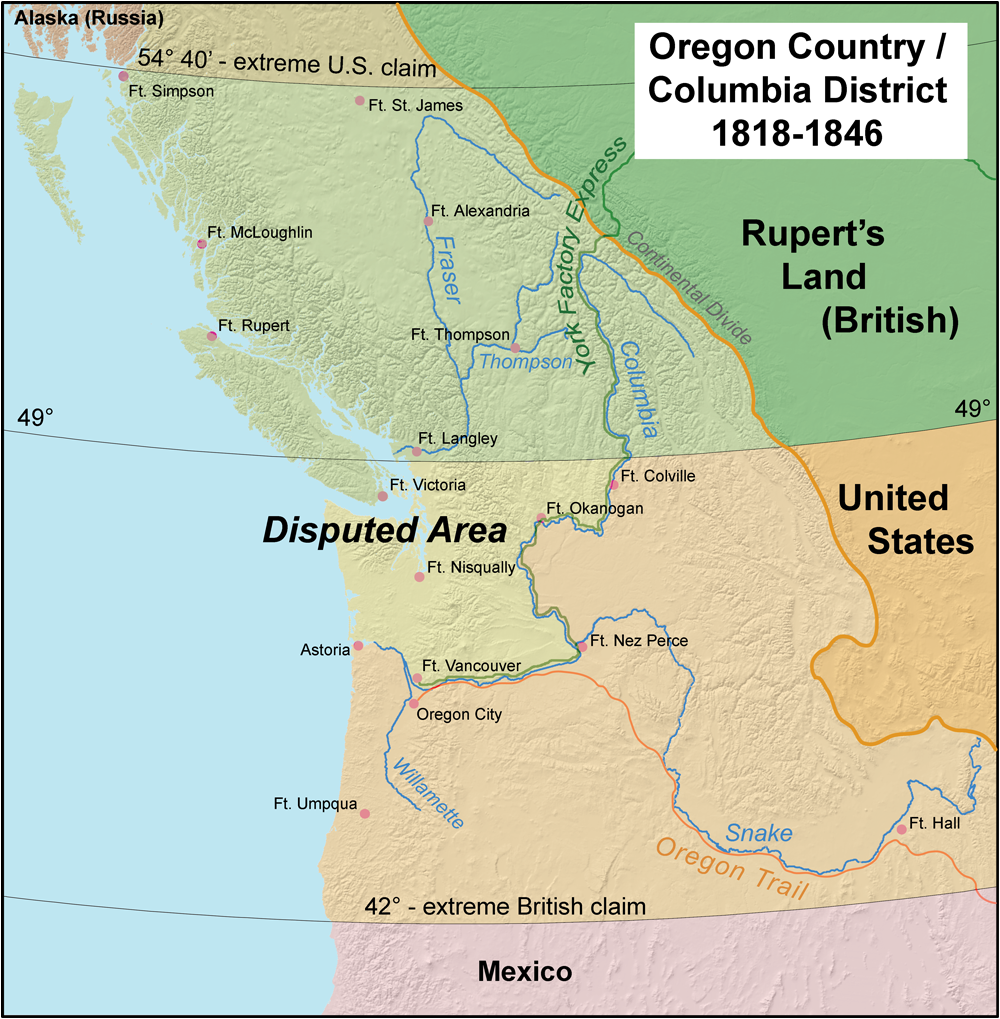
Map of the disputed Oregon Country. Source: Wikimedia Commons.
The border between the United States and British North America had been a longstanding point of contention between the two powers. Their border issues would be partially resolved with the Convention of 1818, when both parties agreed to the establishment of a border along the 49th parallel from Lake of the Woods in modern-day Manitoba to the Rocky Mountains. The Oregon Territory (encompassing the area including present-day Oregon, Washington, and most of British Columbia) would be “free and open” to joint British and American occupation for the next ten years. This arrangement was extended indefinitely in 1827. However, increasing American settlement and growing demands for American sovereignty intensified the dispute over the jointly occupied land.
The American desire for the Oregon Territory stemmed from the then-popular idea of “Manifest Destiny” – a widespread belief that it was the divine right of American settlers to expand their territory across the North American continent. This belief was illustrated by the growing demand to take sole control of the Oregon Territory, thereby expelling British settlers and industry from the Pacific Northwest. The notion of Manifest Destiny became increasingly popular following the election of James K. Polk in 1844, who campaigned on a promise to extend American territory northward. He reiterated this claim during his inaugural address on March 4, 1845, when he declared that “our title to the country of the Oregon is clear and unquestionable” (Polk, 1845). The following year, Polk gave legal notice to Great Britain that the United States would be abrogating the 1827 agreement.
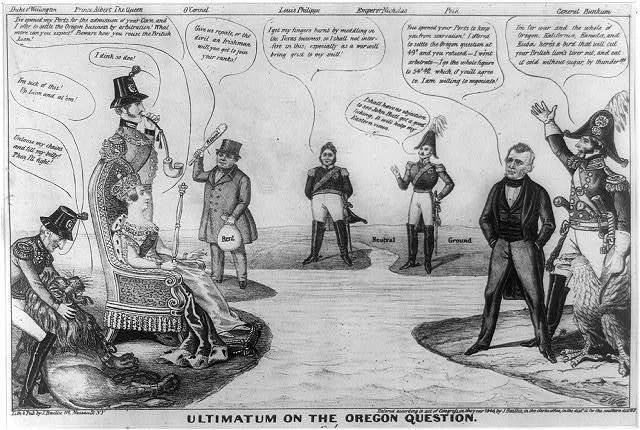
Ultimatum on the Oregon Question, Political Cartoon, 1846.
Polk’s claims to an extended America sparked conversations throughout the growing nation. Echoes of the belief that Americans had the divine right to expand their territory rang throughout the land. Congressman Edward D. Baker of Illinois told the House of Representatives that America has “a higher and better title under the law of nature,” while former President John Adams claimed to the same chamber that the Book of Genesis constituted “the foundation of not only of our title to the territory of Oregon, but the foundation of all human title to all human possessions” (Graebner, 1968, xxxix, 104).
In the face of such claims, the British military authorities were considering how to fortify the Province of Canada. Concerned that any conflict relating to the Oregon Territory could spill across the rest of the border, they decided to fortify and garrison key locations along the border, including Kingston. The waterways surrounding the city made it vulnerable to American attack, as evidenced by the Battle of Kingston Harbour in 1812. It was also only three years prior that Kingston had served as the capital of the United Province of Canada (1841-1843), imbuing the city with additional sentimental value. Due to Polk’s successful election and the ongoing uncertainty surrounding the Oregon Question, it was decided to build four Martello towers to supplement Fort Henry and the existing blockhouses. The Martello design was selected as it could be constructed in a relatively short amount of time.
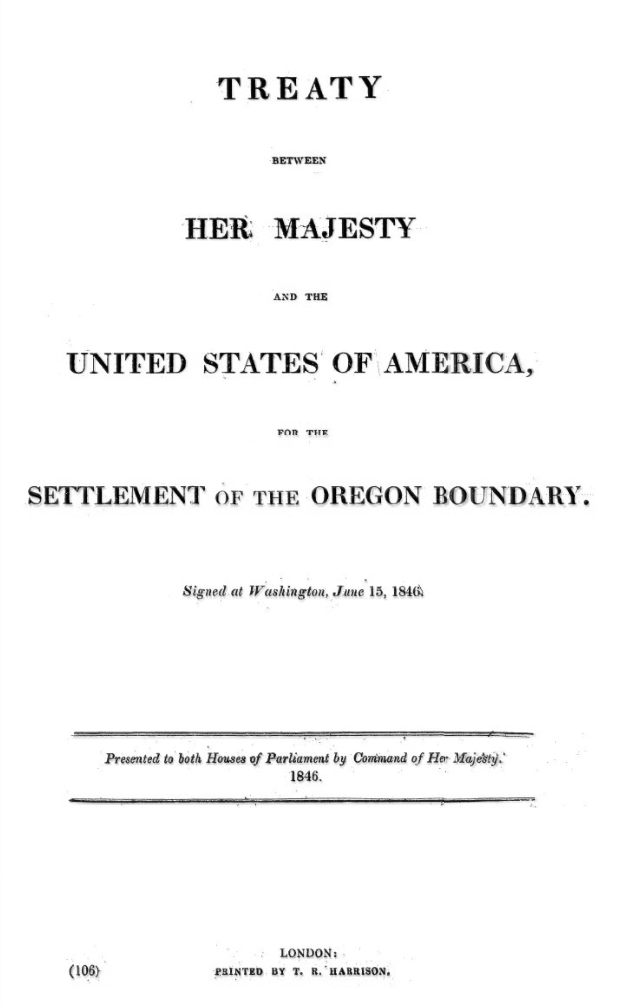
Oregon Treaty, signed June 15, 1846.
The construction of the Murney Redoubt, the westernmost Martello tower, was made official on January 17, 1846, when engineers marked out the position of the tower on the land then known as Murney’s Point. They worked tirelessly to complete it, spurred on by the threat of war, until June of that year, just three months into construction. It was on June 15, 1846, that the Oregon Treaty was signed.
Both Britain and the United States, reluctant to go to war, had been engaged in negotiations over the Oregon Territory for several months. They ultimately agreed to the terms of the Oregon Treaty, which extended the border along the 49th parallel to the Pacific Ocean but kept Vancouver Island within British North America. It was also agreed that British subjects living in the Oregon Territory south of the 49th parallel would retain navigation rights on the Columbia River. Weighing on Polk’s reluctance to go to war was an escalating conflict over the border with Mexico, which led to the Mexican-American war of 1846-1848. Although the Oregon Crisis was resolved for the time being, the construction of Murney Tower continued and was completed in November of that year. The other three towers – now known as Fort Frederick Tower, Shoal Tower, and Cathcart Tower – were completed in 1846, 1847, and 1848, respectively.
Today, the Martello towers of Kingston stand as monuments to a past that many have forgotten, but one that continues to shape the city’s distinctive identity. These fortifications were once a staple of military life in Kingston, housing dozens of soldiers and their family members throughout their lifetimes. Now they decorate our shoreline, a testament to the nineteenth-century engineering and craftsmanship that have allowed them to stand the test of time. Murney Tower Museum, opened in 1925 inside the tower, provides locals and visitors from around the world with an opportunity to remember the tumultuous histories of these red-roofed limestone fortifications and appreciate the severity of a war that never was.
Bibliography
Manifest Destiny. Edited by Norman A. Graebner. New York: Bobbs-Merrill, 1968.
Moorhead, Earl. “Murney Point: Its Evolution Within a Civilian/Military Dialectic.” Historic Kingston 35 (1987): 65-84.
Nicholson, Norman L. "Convention of 1818." The Canadian Encyclopedia. Historica Canada, February 6, 2006.
Noakes, Taylor. “Oregon Treaty.” The Canadian Encyclopedia. Historica Canada, February 7, 2006.
Orchard, David. The Fight for Canada: Four Centuries of Resistance to American Expansionism. Westmount, Quebec: Robert Davies Multimedia Publishing Inc., 1999.
Patterson, William, “The Construction Diary of Murney Tower: A Diary of 1846.” Historic Kingston 28 (1980) / 29 (1981): 43-52.
Polk, James K. “Inaugural Address.” Transcript of speech delivered in Washington, DC, March 4, 1845. https://avalon.law.yale.edu/19th_century/polk.asp.
Preston, R.A. and W.S. Lavell. “A Story in Stone: A Few Interesting Facts About Murney Redoubt.” Historic Kingston 11 (1963): 47-51.
Robinson, Amanda. "Manifest Destiny." The Canadian Encyclopedia. Historica Canada, February 29, 2016.
Saunders, Ivan J. ”A History of Martello Towers in the Defence of British North America, 1796-1871.” Canadian Historic Sites: Occasional Papers in Archaeology and History No. 15. Ottawa: National Historic Parks and Sites Branch, Parks Canada, Indian and Northern Affairs, 1976.
“Treaty between Her Majesty and the United States of America for the settlement of the Oregon boundary.” Signed June 15, 1846. Canadiana. https://www.canadiana.ca/view/oocihm.41583/2
Wilson, Theodore A. and John Alan Ross. “United States Acquires Oregon Territory.” EBSCO, 2023.