
A Boy, a Storm, and Becoming a Museum
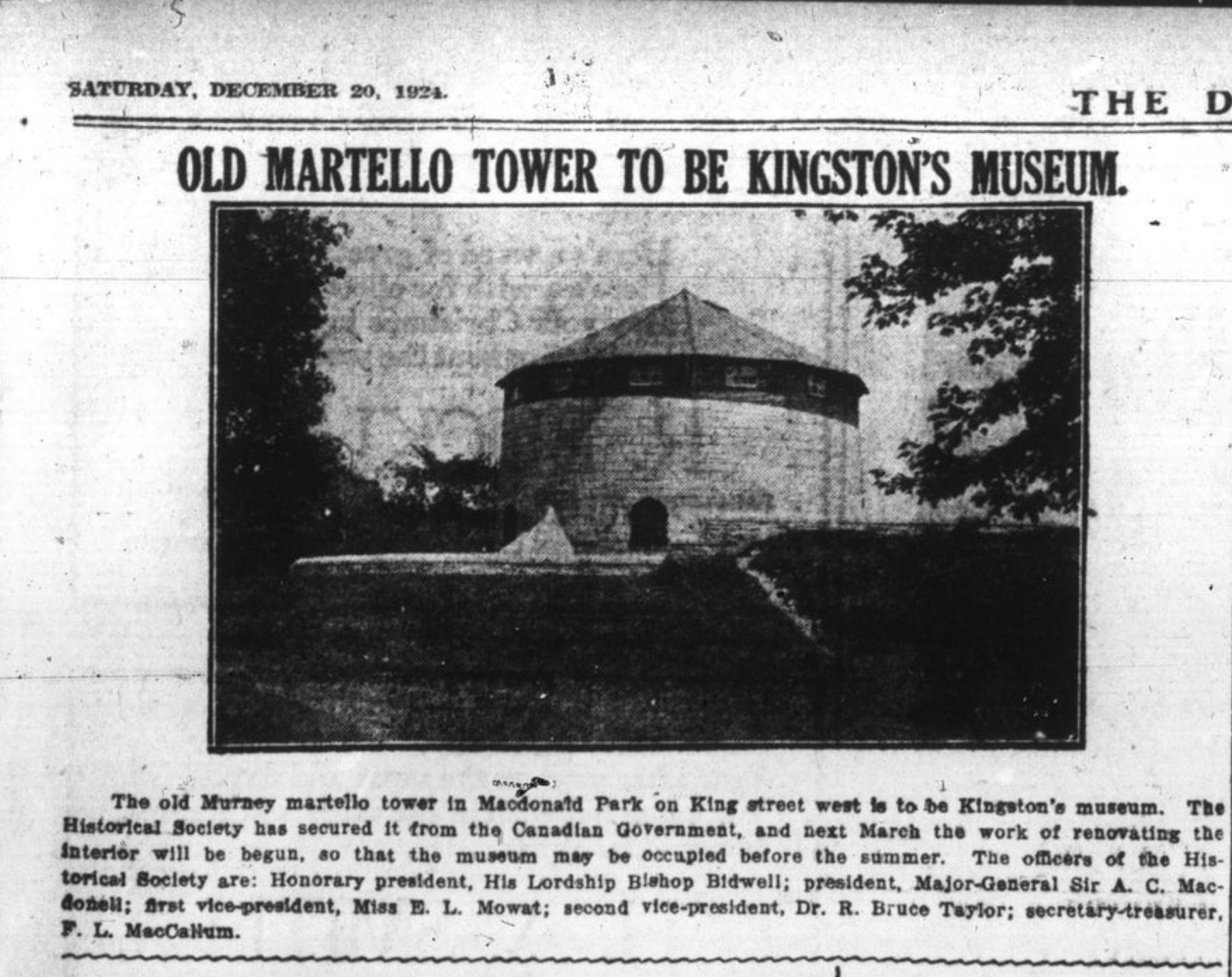
Daily British Whig. “Old Martello Tower to be Kingston’s Museum.” December 20, 1924.
The Forgotten Tower
Nestled on Kingston's shoreline stood a forgotten tower. People would hurry past it - on their way to work, to class, or to the nearby shores of Lake Ontario. A few may have spared it a glance; most likely never noticed it at all. But Murney Tower had already become a quiet part of their story.
Built in 1846 as part of the city’s harbour defences, the tower protected Kingston until 1885, when the soldiers who occupied the tower left. After that, it stood empty, slowly slipping from public consciousness. Certain voices spoke out in favour of its preservation. In 1894, Dr. C.L. Curtis, city councillor and Chairman of the Civic Parks Committee for many years, advocated the tower’s transformation into a museum, even travelling to Ottawa to request governmental support. His efforts did not succeed at the time, but they did bring the tower’s plight into public view. By 1908, however, the demolition of the nearby blockhouse raised fears that Murney Tower might be next. For years, opinions about the tower’s fate fluctuated, while it quietly decayed.
Then came the storm of September 30th, 1921.
The Storm That Changed Everything
At about 12:15 p.m. on Friday, September 30th, 1921, a sudden storm struck Kingston. It lasted only minutes, but caused incidents all across the city.
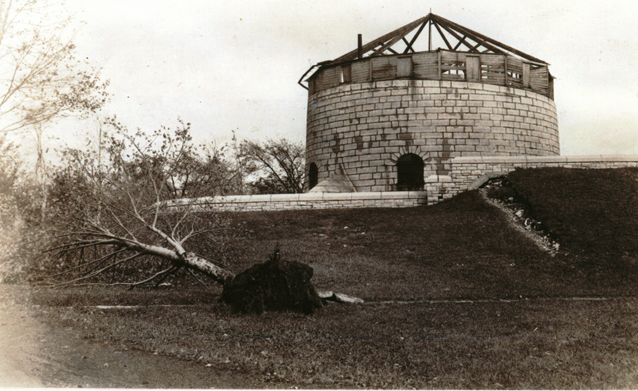
View of the Murney Redoubt in 1921 after the storm tore the roof off. Image courtesy of Queen's University Archives.
Among those caught in its path was a twelve-year-old boy, Donald Maclean. Donald was walking home from school when, at the corner of O’Kill and Barrie Streets, tragedy struck. Sheets of planking and tin tore loose from Murney Tower’s roof, hurling through the air. One piece struck Donald, resulting in the immediate death of the young boy. Neighbours carried his body to a nearby house. There, the coroner confirmed the cause of death: “fracture of the skull, accidental” (Ontario Death Registry 1921).
The storm thus made clear that Murney Tower was not simply a relic of the past, but a neglected structure capable of still affecting the present.
The Maclean Family’s Ties to the Tower
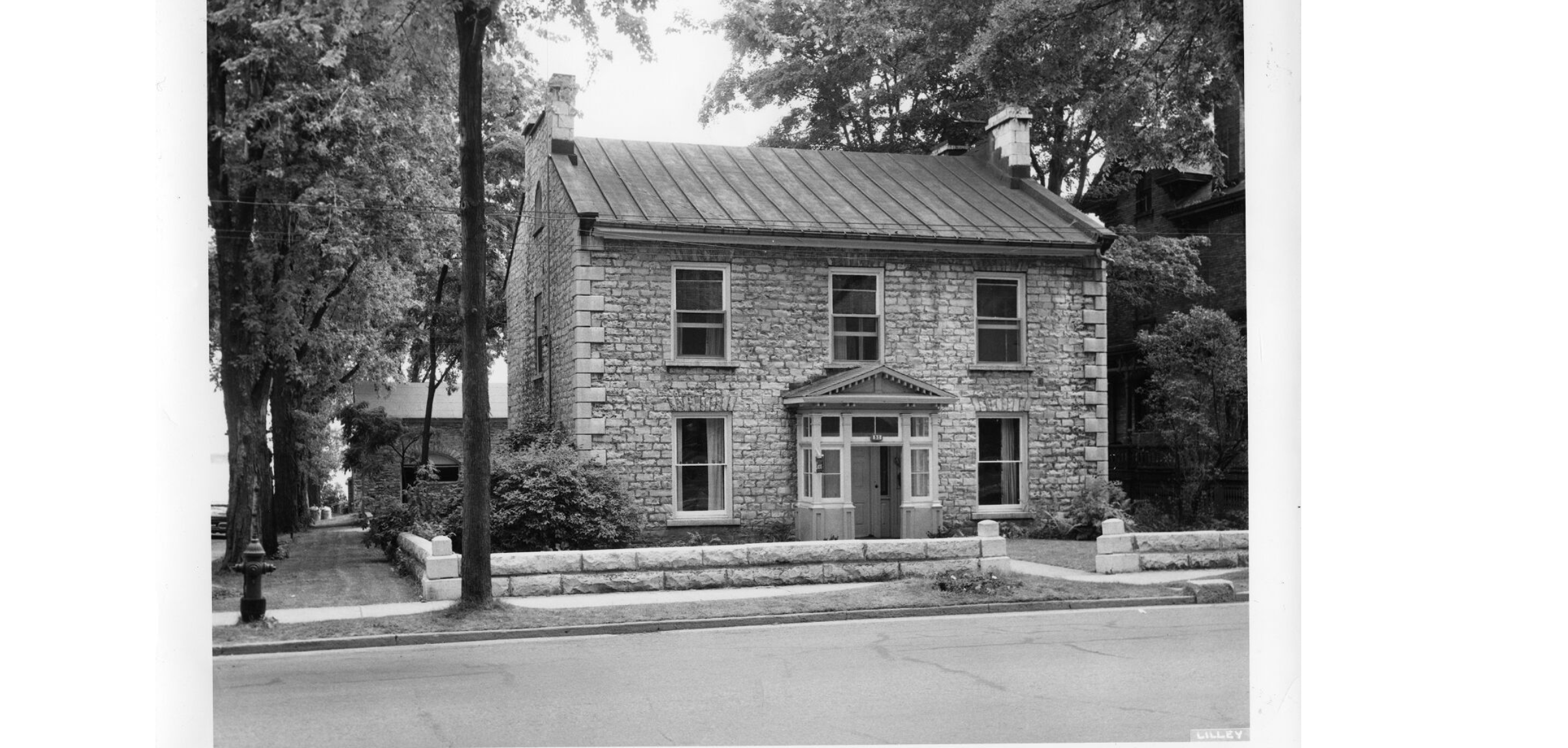
Front view of the Maclean Residence located at 53 King St. E. on the corner of King & Maitland Streets. Image courtesy of Queen's University Archives.
Donald’s death in 1921 was not the only connection between the Maclean family and the abandoned fortification. In fact, Donald had been born inside what was historically known as the “Murney House” at 53 King Street East. His father, Andrew Maclean Sr., purchased the property in 1885 from Harriet Murney, daughter of Henry Murney, a prominent Kingstonian who had owned Farm Lot 24 - the land on which Murney Tower was constructed. Donald’s funeral was held inside the family home on October 3rd, where his uncle, Rev. Canon J. W. Jones, helped officiate. Donald’s short life thus began and ended in a household intertwined with the Murney name.

Entry for Andrew Maclean Sr.’s business on Ontario Street in the Kingston City Directory (1920).
The family may have had other ties to the tower as well. In the 1850s, Andrew Maclean Sr. founded A Macleans & Sons Grocer, where he sold staples such as pork, flour, tea, sugar, and salt. For decades, he was Kingston’s only pork packer. While there is no direct evidence, it is possible that his store supplied provisions to local militia or garrison detachments. During the early nineteenth century, salted pork was a standard component of a soldier’s diet, and such rations were often sourced from local businesses. From their home to their shop, and even to the death of their young son, the Macleans illustrate how the lives of Kingstonians could be closely intertwined with that of the tower.
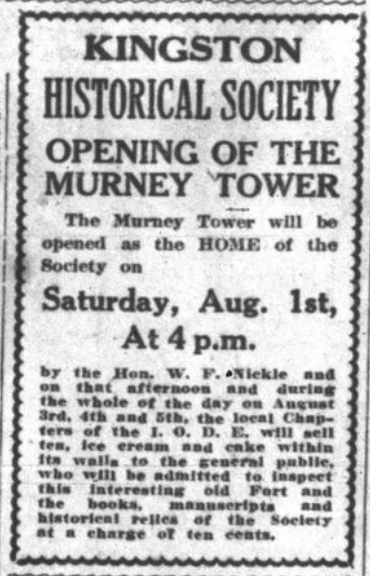
Excerpt from the Daily British Whig, July 31, 1925.
The Museum is Formed
Five days after the tragic incident, the militia authorities repaired the tower’s roof. However, a larger question remained: what should be done with the tower? Suggestions surfaced: turn it into a lighthouse, a bandstand… or maybe a museum. The Kingston Historical Society had for some time been advocating the conversion of the tower into a museum and, in 1923, the Society submitted a formal proposal to this end, declaring that “the egg will prove to contain a swan” — a metaphor suggesting that the humble tower held great potential (H.C.W. to A.C. Macdonell 1923). One year later, in December 1924, the militia finally agreed, and the Society began raising money to fund the necessary repairs.
The community gave their support. Funds were raised, grants secured, and, on August 1st, 1925, Murney Tower Museum opened. Visitors enjoyed cake, tea, and ice cream as they stepped inside the tower for the first time. The local newspaper reported that locals were marvelling how they had “lived here all my life, and yet I never have been inside the Murney Tower before” (“Keen Interest Shown in the New Museum” 1925) — a sentiment still echoed by many visitors today!
Why Donald’s Story Matters
Donald Maclean’s death may not have directly caused the creation of Murney Tower Museum, but it was one of several key moments that shaped the tower’s trajectory. From the efforts of city councillors to the persistence of the Kingston Historical Society, many people and organizations helped bring the museum to life. However, it was the storm of 1921 and Donald’s tragic death that forced Kingstonians to refocus their attention on the tower as both a part of their history and their lives. Families such as the Macleans reveal how deeply the tower was already woven into the social and economic lives of Kingston’s residents. Whether through preservation efforts, familial ties, business transactions, or simply passing by, Murney Tower has long been a fixture of Kingston’s past and present.
Bibliography
Attestation Paper, 6 March 1916, Accession 1992-93/166, Box 2119, File 42, Canadian Expeditionary Force (CEF), Library and Archives of Canada, Ottawa.
“Cappon, James (1854-1939).” Queen’s Encyclopedia. Accessed August 28, 2025.
Daily British Whig. “Burial of Donald Maclean Victim of Friday’s Cyclone.” 1921. Digital Kingston.
Daily British Whig. “Cyclone Strikes Kingston: Falling Roof Kills a Boy.” September 30, 1921. Digital Kingston.
Daily British Whig. “Cyclone Wrought Much Destruction in Kingston.” October 1, 1921. Digital Kingston.
Daily British Whig . “Deputation to Ottawa.” April 14, 1896. Digital Kingston.
Daily British Whig. “Flour.” January 20, 1914. Digital Kingston.
Daily British Whig. “For Sale.” November 19, 1921. Digital Kingston.
Daily British Whig. “Historic Heirlooms of Kingston Should be Preserved.” November 17, 1908. Digital Kingston.
Daily British Whig. “It Is ‘Perfect.’” July 24, 1909. Digital Kingston.
Daily British Whig. “Keen Interest Shown in the New Museum.” August 4, 1925. Digital Kingston.
Daily British Whig. “Kingston Historical Society: Opening of the Murney Tower.” July 31, 1925. Digital Kingston.
Daily British Whig. “Kingston in History.” July 3, 1917. Digital Kingston.
Daily British Whig. “Murney Tower.” October 19, 1921. Digital Kingston.
Daily British Whig. “Obituary.” 1924. Digital Kingston.
Daily British Whig. “Old Martello Tower to be Kingston’s Museum.” December 20, 1924. Digital Kingston.
Daily British Whig. “Our Salt is all Salt.” April 8, 1910. Digital Kingston.
Daily British Whig. “Tea! Tea! Tea!” March 6, 1913. Digital Kingston.
Daily British Whig. “To Replace Tower Roof.” October 5, 1921. Digital Kingston.
Henderson, Robert. “Diet and Food Preparation for the British Army during the War of 1812.” Warof1812.ca, 2024.
Kingston City Directory from July 1919 to July 1920, Including Directories of Barriefield, Cataraqui and Portsmouth. Kingston: Leman A. Guild and George Hanson, 1920. Internet Archive. Accessed August 28, 2025.
Kingston Picture Collection. “Murney House.” August 3, 1959. Queen’s University Archive.
Macdonell, A. C. Letter to A.E. Prince. “Kingston Historical Society Correspondence,” March 14, 1921. – Kingston Historical Society fonds, Series: Correspondence, File: 1921; Locator: 2289.1, Box 1, File 3; https://db-archives.library.queensu.ca/correspondence-6901
Maclean Jr., Andrew. Letter to Kingston Board of Health. “Business Correspondence,” 1919. – Letter, 1919 Jan. 16 to Kingston Board of Health.; Locator: 2999 (MacLean); https://db-archives.library.queensu.ca/letter-1919-jan-16-to-kingston-board-of-health
Murray, Thomas. Letter to J. H. Mitchell. “See Kingston Historical Society,” December 2, 1925. - Kingston Historical Society fonds, Series: Correspondence, File: 1925; Locator: 2289.1, Box 1, File 7; https://db-archives.library.queensu.ca/correspondence-6905
"Ontario, Canada records," images, FamilySearch, image 422 of 1748; Archives of Ontario. Image Group Number: 004529958.
Ontario Death Registry. Death Registry for Donald Maclean. September 30, 1921, no. 013322, Kingston, Ontario. Accessed November 13, 2025.
Reid, William. “Reid’s Marriage Notices.” Ancestry.com. 1848, 345.
The United Empire Loyalists Association of Canada. The Old Stones: A Walking Tour. Kingston, Ontario: First Capital Days, n.d.
W., H.C. Letter to A.C. Macdonell. “Kingston Historical Society, Royal Military College Letter,” November 30, 1923. - Kingston Historical Society fonds, Series: Correspondence, File: 1923; Locator: 2289.1, Box 1, File 5; https://dbarchives.library.queensu.ca/ correspondence-6903